

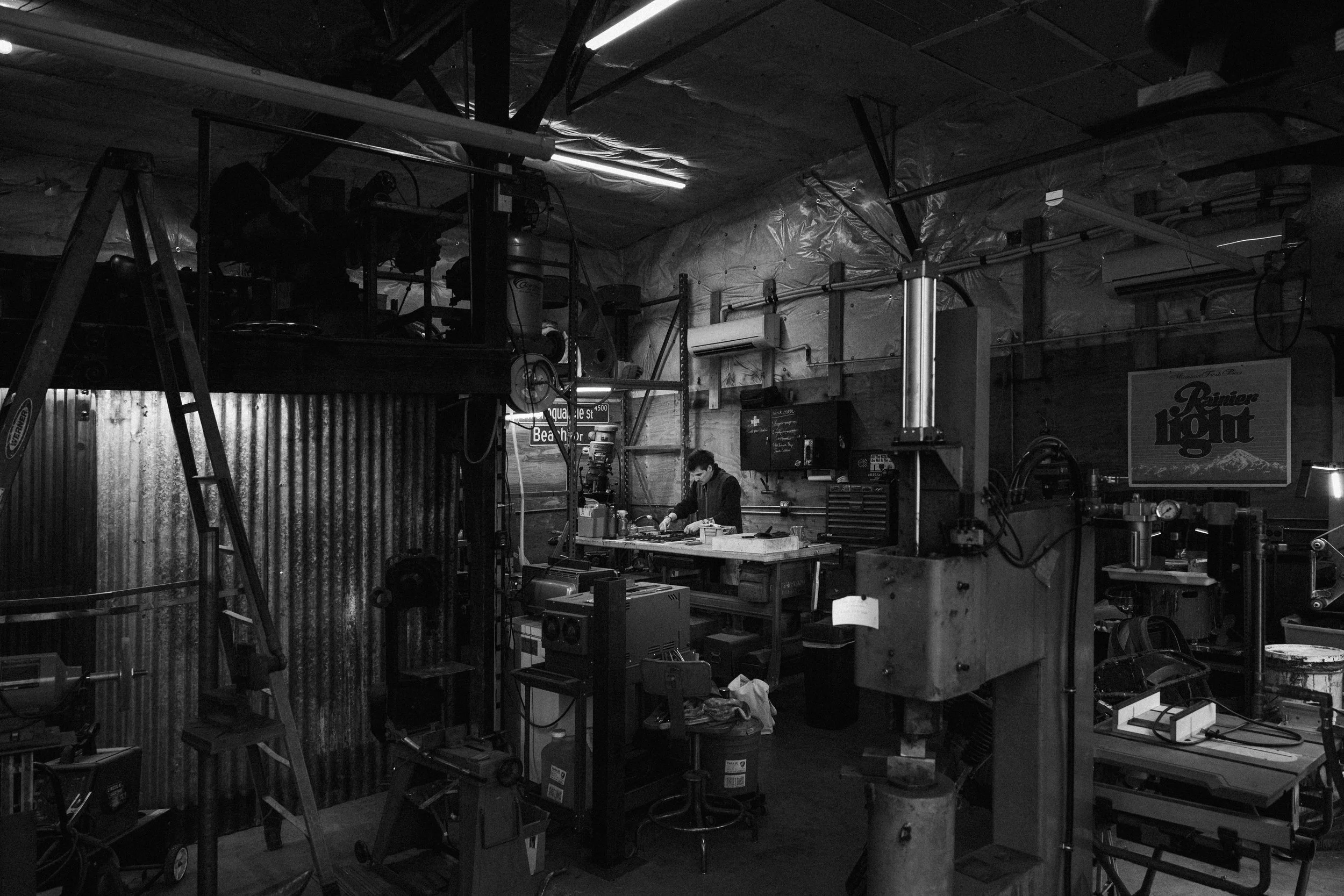
Noah Larson makes kitchen knives by hand in Seattle under the name Larson Made. Devon spent an afternoon in his shop while he finished a holiday batch. Nobody was given lines. Noah talked about the car crash that led him to knife making, why knives stopped being handed down, what a $500 knife does that a $50 one doesn't, and why he stopped buying exotic wood. Three moments were cut as clips. The rest is here in the transcript, with private passages marked where they were withheld. The original files are fingerprinted at the bottom of this page.
Three moments
Each clip is labeled with where it sits in the full conversation.
Why we stopped handing knives down
Maybe I don't want to buy a thing for the fourth time in three years.Read it in the full conversation
Cooking for her
Why am I not making these tools that I'm using to help nourish and sustain her?Read it in the full conversation
Where the wood comes from
I'm buying this piece of wood that I find beautiful, and people are losing their lives over it.Read it in the full conversation
Photographs
The full conversation
Lightly cleaned for reading: filler words and false starts trimmed, wording kept as spoken. Gray tags mark private passages that were withheld. Italic notes describe moments that were not words.
Part I
00:00 to 20:49Recording begins as Noah turns the shop music down.
DevonWhen I think of where I was when I first got into photography, I was super shy. Taking my mom's camera was a way I could ask people for one-on-one time and learn how to communicate better. What do you think of when you think of the first time you made a knife?
NoahThat's a great question, and it's jam-packed with a lot of nuance about what was going on at the time. When I started knife making, it was right after a pretty bad car wreck that my partner and I were in, and I could no longer perform at the level I wanted to as an athlete in college.
NoahSo I was looking for my next outlet. Making in general, and then finding my medium in knife making, gave me this incredible independence, this freedom I had felt was stripped from me at that time. That was what first helped me start to gain my sense of identity outside of being an athlete and a college student in my early 20s.
DevonHow did it get to knife making?
NoahI started by combing through YouTube for any and all outlets, and I found Adam Savage from MythBusters, who's a really cool human. He advocates for making anything and everything, and he has a shop built around being self-sufficient. So I started making all kinds of things, and then I thought, I would like to make something useful.
NoahIn my upbringing I've always had really cool blue-collar humans around me who worked with their hands. A knife felt attainable. It's something people make. So I just tried it one day without any of the proper tools, just what I could find in my dad's garage. And I was like, this is so intensely complex. Knives are viewed as just a cutting tool, but the geometry, the heat treat, the metallurgy, the ergonomics, the design. There's so much more to it than just a knife. It kind of enveloped me.
DevonWas it the first thing you tried making?
NoahI started by hanging some ax heads on handles, because I had ax heads lying around that needed handles. Adam Savage's whole career has been making props and costumes for movies, so I started making props too. I made the Winter Soldier arm out of foam and painted it to look like mirror-polished aluminum, and a couple of masks for my cousin. It was cool, but I wanted something more physical. And I really didn't like the waste. Plastic and petroleum byproducts going straight into the landfill.
NoahThat was my first step in figuring out my identity. Little bits of my upbringing started to shine through. My mom is a career gardener, and I grew up watching Studio Ghibli all the time, and the undertone of so many of those films is humans mistreating the Earth. I didn't want to create a bunch of waste. I wanted to make something useful and let it evolve.
DevonBig Studio Ghibli fan.
NoahBig time. I watched my first one when I was five or six, and it stuck with me. You could name any of the Studio Ghibli films and I'd be there.
DevonWhat's the last one they put out? The Boy and the Heron? It's on my watch list.
NoahYou haven't seen it? Oh, come on. I dragged my mom and dad to it, because they put me on to Spirited Away and all of that when I was pretty young. They said it was pretty slow, and I'm like, what? It's so good. Studio Ghibli is supposed to be approachable for kids, with undertones that adults understand. The pacing can feel slow, but there's so much nuance happening. It's extremely well made. I'm very grateful I got to watch those movies growing up.
DevonWhat are you doing right now?
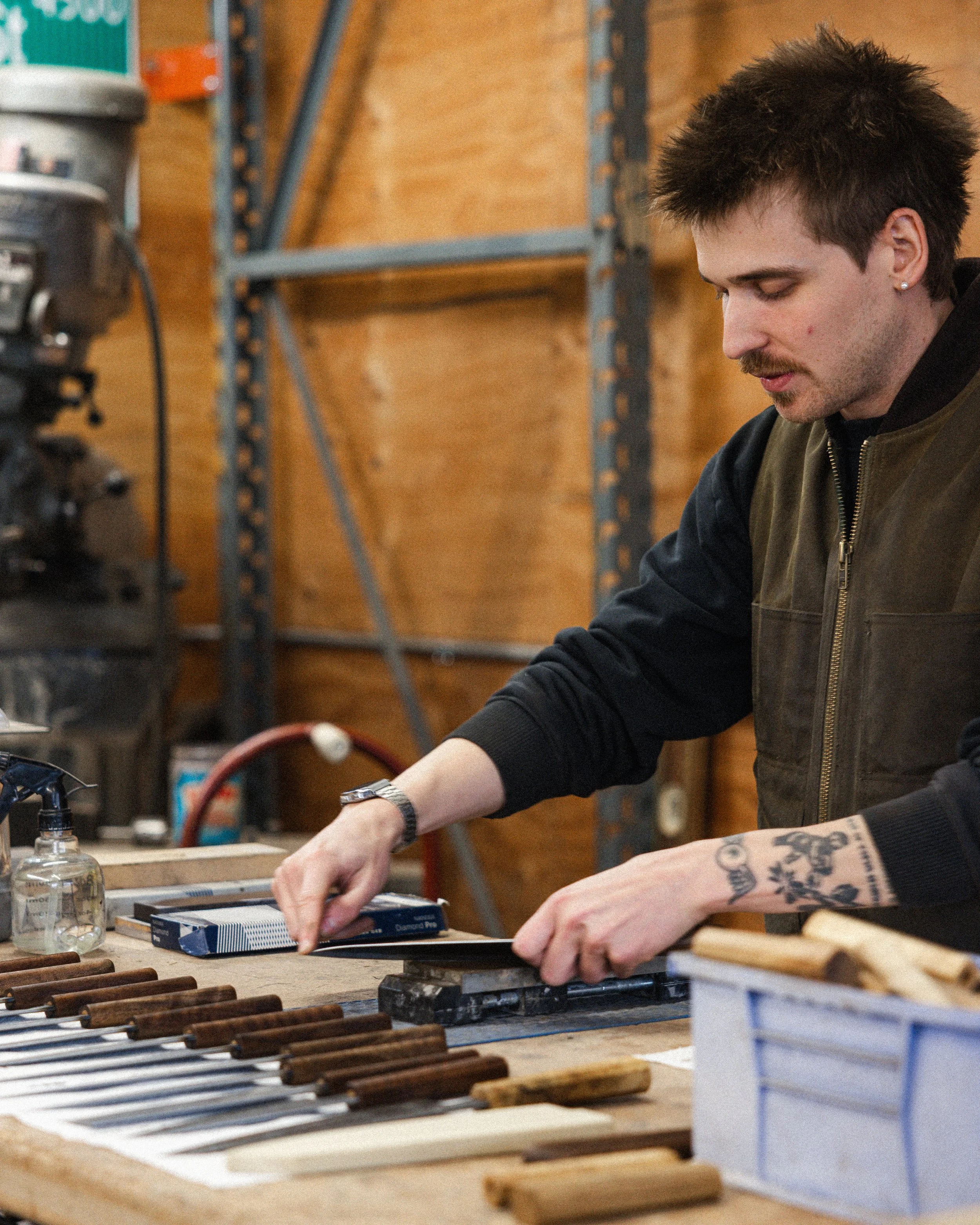
NoahJust throwing some edges on these knives. They're for a restock on Sunday. Every four to six weeks I put a batch of inventory up on my website, and this is one of my two batches going up for the holidays. I finished them in the last couple of days.
NoahSome of these are custom orders, and this is a new series called the Old Schools. They're inspired by knife makers of the past, old brands like Sabatier, Case, Chicago Cutlery and Lamson. So it's a more Western profile with a Western handle, calling back to traditional knives, with my spin on it: understanding the metallurgy more in depth, heat treating the steel better, and a slightly different approach to design and to manufacturing on a small scale.
DevonYou said you made them more your own. How?
NoahMy style is keeping my forged texture and a really low bevel on all my knives, and that's a byproduct of not wanting to use a lot of abrasives. I forge all my geometry in really, really thin. I move the steel with heat to where I want it instead of removing it with abrasives. One year I had a pile of used abrasives at the end of the year almost as tall as I was, and I had that moment again of, I don't want to throw this away. This feels bad.
NoahAnd I construct them more like a traditional Japanese knife. Instead of seeing steel all the way through the handle like a lot of Western knives, the tang is hidden inside the handle, so you get this really nice transition from a full wood handle into the blade.
DevonIt looks so cool. Are you pretty consistent with this style?
NoahOn the steel itself, I love doing this really low bevel. It's harder to achieve, but it takes fewer resources. It just takes more skill, a little more finesse.
DevonWhat did your first prototypes look like compared to now?
NoahI started Larson Made just over three years ago, almost four now. I started with a Western chef knife that was full tang, so you could see the steel through the handle, and they felt a little clunky to me. So I moved to Japanese-style construction and honed all my processes in on that. This one's a little special. It's not a mono steel, it's a san mai.
NoahAt first I wasn't forging at all. I was doing stock removal: cutting my profile out of a bar of steel and grinding it into shape. That's a lot of work, a lot of abrasives and a ton of time, and I didn't like standing at the grinder throwing steel at the ground. That felt really bad.
NoahOnce the Japanese knives felt streamlined, I started thinking about what's next, what feels more true to me. My partner says this to me all the time: you aren't good at ever plateauing, even for half a second. When I get to a point where I understand all my processes, I'm immediately asking what needs to change. What can I do better on the next batch? What can make the product better? What can make the packaging better?
DevonThere's still a style that ties all of them together. I've jumped ship in my own work too, and I think I've figured out that's okay as long as there's some consistency, so people know, that's a Larson Made.
NoahI agree. Jumping ship 180 degrees from what you were doing is super polarizing, not only for yourself but for the audience or client base you're building. Small changes are different. A lot of people won't even notice them at first, but when you look at the knife two years later, it looks completely different, and it doesn't feel polarizing because you were building up to it. For me it's fun, because I get to pick a skill I want to get better at and let that show in the work.
DevonThis looks insane. Explain this one.
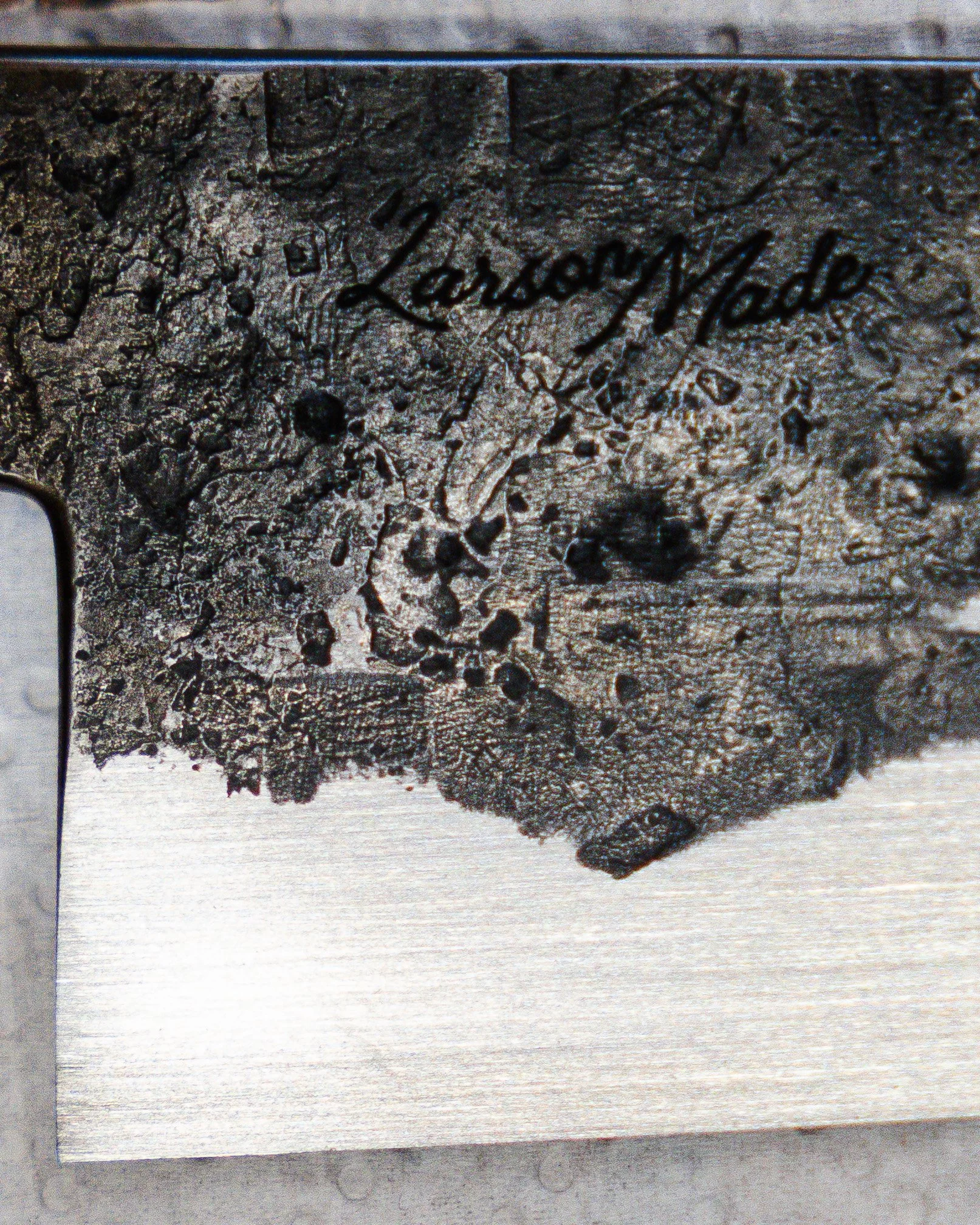
NoahIt's a core steel. You can see it best at the spine, that black line. The core is the hardened steel, and the jackets on either side are softer. I didn't make this piece of steel, although we can in-house. In Japan there are whole villages devoted to knife making, and this came from a steel-making village called Takefu. They're the best in the world at Japanese laminated steels. It's stainless jackets on either side of a high-carbon core.
NoahThen I forged it, which is extremely skill-heavy, because you have to keep the core centered while you forge. The jacket is soft, and the core doesn't want to move as much. It's really stressful, because you can get to the end, grind your bevels and realize you forged the core out of straight and there's no hardened steel on the edge. That's heartbreaking, especially because it's not a cheap piece of steel. But it turns into an absolutely gorgeous, really special knife.
DevonWas this your first go at it?
NoahMy first go at forging san mai, yeah. I got really lucky. You can see the core gets really close to the edge in a couple of places, and I got by by the skin of my teeth. The big thing with san mai is that the jacket can come down near the edge on one side, as long as it's not reflected on the other side. That means when you sharpen, you're only sharpening the hardened core steel. It's just super stressful.
DevonHow much does a bar of that cost you?
NoahThis bar was about 70 bucks, and the steel that went into this one knife is about six dollars' worth.
NoahLet me give you a quick rundown. Come with me. I cut all my material on the bandsaw into standardized sizes. Those knives you just saw start as a bar of steel like this. The first thing I do, on this gorgeous power hammer, is forge in the tang that goes into the handle while the steel is hot. Then I forge in the distal taper at the spine and bring down my bevel, so I get my final heel height and all that.
NoahSo it goes from that to that, and now it's starting to look like a knife. This is the ricasso, which is just Italian for the space between the handle and the edge, and this is the tang. I forge oversize, so it looks like a rectangle with the right dimensions, then I trim it on this shear, which was actually made here in Seattle, and finalize the shape on the grinder.
NoahThere's usually not a motorcycle in here. My grandfather stopped by with a bunch of stuff for me, which was awesome. But I also don't have space for anything.
DevonAre you making the handles too?
NoahI do every single thing in house that I can. This is the last walnut Western handle left from this batch. For the Japanese knives I do two handle sizes, a smaller one for a petty knife and a larger one for knives seven inches and up. I batch them, usually 50 or 60 handles at a time, and I can get through a batch in two or three days. The Japanese-style handles are just a tapered rectangle with chamfers, so they're quick. The Western ones took more hand finishing. There are a lot of firsts in this batch. It's the first time I've made Western handles in production.
DevonYour site says service for life. Has anyone come back?
NoahOh, yeah. Most people who come back say someone came over and used their knife, and now it's hurt. There's a big chip out of the edge, or the tip is gone. I think that's sometimes a little bit of a disguise for what actually happened. And I tell them, I make these knives knowing they're working tools. They're going to get hurt. It just happens. Don't ever feel embarrassed to come to me and say my knife needs to be fixed.
NoahBecause my knives are considered higher end, people tend to treat them a little nicer. But some come in with a chip or a broken tip, or they've been dropped, which happens a lot. I stand by my product, and I make it in a way that's easy for me to service and keep its performance. So although it's a higher price point, you get the benefit of a human who loves what they do and wants your knife to always work, and a relationship with me and with the cutting tool you use to nourish your family.
Part II
20:50 to 37:23NoahThat's why I love working with the chefs I work with. They do what they do because they love nourishing their communities. To be a local human making their cutting tools and servicing them is a really nice little ecosystem we've created.
DevonI didn't really understand the value of knives until my mom, who was a chef, told me how much a knife is part of a chef's life. It's cool that it's valued that way.
NoahI agree. I did a lot of research into knives, because there are all these stories of our parents' generation having knives handed down from their grandparents.
NoahSo I started looking into why we don't hear of that anymore, why we're not getting knives handed down. A lot of that came from the Great Depression. People could only afford one or two knives of decent quality, and they had to take care of them because they couldn't afford to buy them again. That hardship, we can call it trauma, got passed down to their kids.
NoahThen we had so much change in the US. We became a very consumer-based society. We like to throw things away and buy them brand new, and that's just how we set up our country. Now we're seeing a resurgence of people saying, maybe I don't want to buy a thing for the fourth time in three years. Maybe I want to buy something a little more expensive, and the human stands behind it.
DevonI dig it. I also think about the first knife ever made, how groundbreaking that must have been. The world would literally stop if we didn't have knives.
NoahIt's a very interesting conversation, how the view of knives has changed. Even on social media. It's really hard for me to grow there, because Instagram and Facebook categorize me as selling dangerous weapons. So I'm essentially shadowbanned. Most knife makers are. You can search our exact name on Instagram and usually you can't find us. And I'm making tools to make food in a kitchen.
NoahIt makes it really hard to grow the business. Even with the resurgence of more personal business, it's still very necessary to be on social media. It's all loaded.
DevonWhat does a $500 knife do versus a $50 knife?
NoahThat's a wonderful question. The first thing is the quality of the steel and how hard it gets. Higher-end knives use steel with a much different composition, which gives you more performance, durability, toughness and hardness. It also gives the maker the margin to grind better geometry, so the knife stays thinner for longer and doesn't need to be serviced as much.
NoahOver time a lot of knives get really thick behind the edge and start to wedge. Instead of slicing nicely through a carrot, they shoot it across your kitchen. That takes much longer to happen with a well-made knife. Japanese knives can be a bit cheaper because of the lower cost of living there, but in the US, that's what you start getting at around $500.
DevonHow much longer does it last?
NoahThat's all up to the human using it, which takes a little control out of the knife maker's hands. With Japanese knives you'll see pictures of people holding the knife up to show the heel, because that's how you see the geometry and how thin it stays right behind the edge. I forge low bevels so that when a knife needs thinning, I can walk over to my tooling, bring the bevels up a little, thin the edge back down, put my finish back on, and it's like it's brand new.
NoahBut there's a balance. If you go too thin, like a needle, it can be weaker, depending on your heat treat and your steel. A knife maker's job is to choose a steel that's compatible with their style, understand its metallurgy, and combine the right heat treat with the right geometry. That's where it gets complicated. It's not easy or cheap to make these knives perform the way they should.
NoahI make what's considered high-end knives, from about $325 to $600 depending on size and shape, and more for custom orders. But there are people making $5,000 or $10,000 knives. There's no ceiling. I've figured out where my knives fit and how to make them approachable while making them as high quality as I possibly can, without cutting any corners. Knife making as a business is hard to make money at, on top of figuring out how to manufacture properly.
DevonIt's cool that you're making one of humankind's first tools in the 21st century. When did you feel like, yes, I'm starting to lock in?
NoahOnly in the last year, year and a half. I've been making knives for nine years total, and it's only recently that I felt I could hit flow state with my order of operations, get a consistent product, produce the volume and not cut corners. It took almost eight years to figure that out. But that's learning a craft. It started with hunting knives, not kitchen knives.
DevonSo the business is three or four years old, but you'd been making knives well before that.
NoahI had a different business before this, set up for collector pieces and higher-end stuff. I made a collector knife recently because I hadn't in a long time. Let me show you. It's a Bowie knife. That's what I started with, cool stuff like that and hunting knives.
NoahThen after the car wreck, my partner was diagnosed with three closed brain injuries. It's going to be a lifelong recovery, but she's in a really good place now, rebuilding neural pathways. We were in Arizona, where she was admitted to a neurological institute for physical therapy, speech therapy and visual therapy.
NoahWithheld
NoahI remember being down there with her while she was having really hard, long days of therapy. The only thing I could do as her caretaker was make sure she got there and back safe, and make sure she had comforting food when she came home.
NoahIt just clicked with me right then and there: why am I not making these tools that I'm using to help nourish and sustain her? That would be really meaningful. That's when I first thought maybe I should lean into culinary knives. And the second we moved back to Washington, I launched Larson Made and started on the culinary route.
DevonThat's so cool, man.
NoahThat's why I like this business. We talked about vulnerability and owning a business and doing interviews like this. It's really hard to do if you're not incredibly secure, because to be successful you need to be vulnerable and let your business reflect you, and you have to do that in the public eye. When I fail on a batch of knives because I overlooked one thing and have to throw it out, that's devastating. But you still have to be a human talking about your business. You can't fall off the radar for a week while you emotionally recoup.
NoahThat's been the hardest and most rewarding part of running this business, letting it reflect me and being vulnerable. When I fail, I talk about failing, and I fail constantly. I used to dread it. Now it's easy to take it on the chin and say, I learned a lot from this. You learn so much more from failing than from succeeding, and it no longer scares me. I'm no longer scared to talk about it either.
DevonWhat's the most common misuse of a nice knife?
NoahOh, boy. It's usually when people go from thick German knives, like a Wüsthof or a Henckels. They're used to rock chopping. They keep the nose of the knife on the cutting board while they mince an herb, and instead of lifting the front of the blade, they pivot with it still on the board. Because the geometry is thin and the steel is harder, it chips out. That's the number one thing I see when people move from a thicker German knife to a higher-end knife.
DevonI'm sure I do that all the time.
NoahMy parents have always been incredible cooks, but we never had nice knives. When I started cooking, I was watching Jacques Pépin, and he said to pick your knife up off the cutting board when you're mincing herbs. I was drawn to him because he's so simple about cooking. He loves taking humble ingredients and making them incredible. Because he was so influential to me, it stuck, and I've never done it again.
DevonFrom bar steel to box, what takes the most time?
NoahIt's changed so much. It used to be grinding. I spent so much time at the grinder, and then I got bored of it and switched over to forging. Now an eight-inch chef knife takes at most six hours to complete and package, even with a bunch of stumbles, and the smaller petty knives take about four.
NoahThe most time is passive. After you forge, you need a thermal cycle to reset the grain structure, because you've put so much stress into the steel moving it with heat and force. Then an annealing cycle softens it all the way, so I can trim it out, profile it and straighten it before heat treat. When I forge stainless, the anneal cycle is about 14 hours. On carbon steel it's three or four. You have to schedule around it, or else you just sit there doing nothing. After heat treat, it's only about 90 minutes to two hours to finish a knife.
DevonCould you walk me through each stage in depth?
Part III
37:24 to 59:55NoahOf course. Let me open the door and move the motorcycle.
NoahTons of amazing natural light in here. Next week the front shop and this shop are both going to run on solar, which is really cool. It's heated, cooled and insulated. It's a really good shop. I love it here.
NoahThis little guy is the forge. It's a propane burner, and the rest is a volume of air blown through by that blower motor. It gets up to 2,200 or 2,300 degrees at full tilt, in about 15 minutes. A bar of steel goes in, I grab it with tongs, and we go over to the power hammer. The first thing we do is come in from the side and forge in the shoulder, getting it down to about three quarters of an inch.
DevonIs this thing just stamping away?
NoahIt's a 100-pound ram that runs 220 blows a minute wide open. I got it earlier this year. Have you watched Forged in Fire? Their power hammer is a brand called Big Blue. This is one of Big Blue's first or second runs, from the 90s. I got it from a guy in Portland, and it had barely been used. I went through and rebuilt it and replaced everything.
DevonBefore this, you were doing it all by hand?
NoahI started forging around October of last year, fully in production, by hand, and I realized it wasn't sustainable, so I immediately bought a power hammer. Some blacksmiths go for years by hand. My shop mate is in his mid-30s and still forges almost everything by hand. We're restoring a power hammer for him now. I told him, you're going to regret that when you're 70 or 80. You won't have any elbows or wrists.
DevonHow do you learn to rebuild something like that?
NoahBefore I bought it, I called Big Blue and asked what was up with this machine. They gave me the specs, told me when it was made, and said they'd help me service it. Then I started tearing it apart and asked for the diagram they'd promised, to understand how the five-way valve system works, and I couldn't get hold of them for two and a half weeks. So I had to teach myself.
DevonThat's another skill, though. When something goes wrong, you'll be able to fix it.
NoahIt literally went wrong three weeks ago. These things are always 30 seconds away from pulling themselves apart. That's the nature of how they work. They're violent machines, and loud. I wear earmuffs, and sometimes I double up. Withheld I take PPE in this shop super seriously, because I want to do this for a long time. Blacksmiths not that long ago had a lifespan of about 35 years.
DevonSo you smack it down to this with that thing? How does that work?
NoahThe steel is hot enough that it's super plastic. As long as you're indexing correctly on the dies, the energy transfers from the top die into the bottom die and it won't slip on you, unless it gets too cold. Then it starts to twist. You can feel it, and you can see it in the color.
NoahThe next step is drawing out the taper, so it gets thinner and thinner toward the spine. The last thing I do is pull the heel and the bevel, all on the same dies, going back and forth. The taper and bevel go really fast, two or three heats each. The tang takes longer, because it's a lot of stress to push that material, and it's easy for it to mushroom over and crack.
NoahAnd with stainless steel, I'm one of the only people production forging it. That's a whole other mixed bag. If you get it too hot, the grain structure is horrible and the whole knife tries to crumble on you. Stainless is air hardening, so if you let it get too cold while forging, it just stops moving. It's a really fine temperature range, and if you screw up, you have to throw that knife out. That hurts, because stainless is much more expensive than carbon steel.
NoahFrom there, it goes into that gray kiln for the annealing cycle. It goes up to 2,200 degrees too, in about 15 minutes. It's basically a high-performance oven.
DevonIs this what it looks like coming out? It doesn't look any different.
NoahIt doesn't at all. The difference is the grain structure is now soft and pliable, so I can straighten it. Before heat treat, everything has to be straight, because once the steel is hardened, it's a bear to get it back. Annealing means bringing it up to almost its critical temperature, where the alloying elements dissolve into solution and the grain gets very uniform, then cooling it super slowly so everything relaxes and sets in that relaxed state.
NoahFrom there I cut out my profile on this shear. I was using the bandsaw, but having something mechanical and made in Seattle is extremely cool. Then I clean it up on the grinder. These pilot knives have been heat treated, and that's what they look like going in too. The spine and heel are rounded over and polished, the knife is extremely straight, and the tang dimension is cleaned up.
DevonI'm still confused how it goes from this to that.
NoahThat's fair. I have a bunch of stencils. I trace out what I want, cut it out, and refine it on the grinder so all the edges are smooth. Then, since it's still soft, I go back onto the anvil and hit it with a hammer until it's straight. That's easy if all the warps are in the same plane. If there's a twist, it sucks. Twists are the one bane of every knife maker who forges. Once you have an eye for it you can avoid them, but a lapse in judgment for half a second gives you a twist that ruins your day. And steel has a memory, so sometimes it picks the warp back up in heat treat, when it's hard and more brittle and much harder to straighten.
NoahFor the rest of it, I'm on two machines. First, this grinder, grinding a concave bevel on a contact wheel with an abrasive belt. Because the knife is forged, none of the surfaces are even or straight enough to give yourself guidelines, so you grind by eye, and you can get yourself into trouble really fast.
NoahAt this stage I'm grinding the edge down to about ten thousandths of an inch, which is like three sheets of printer paper. If the edge is a couple of thousandths out of straight, that's a third of your thickness, and the whole knife looks horribly off. I straighten a lot of that out on this machine, which I made. It's a late-70s pottery wheel I had an abrasive disc made for. Water runs on it the whole time, and I flatten the bevels by hand, setting my thickness and my straightness.
DevonCould you have done all of this by hand?
NoahI did. It took a couple more hours per knife. The grinding is all still by hand. I had this conversation with a couple of chefs recently, actually Mark at Cornelly. It's not just four to six hours of labor to make a knife. It's four to six hours of perfect labor. I can't make a mistake, because if I do, I have to start all over. What looks like a small screw-up to someone outside knife making means that knife is gone, and that hurts. You can't let it go out at that price point. And there's probably some knife-maker vanity of, I know I can make it perfect.
NoahChefs understand. If one thing in your recipe goes wrong in a big batch, you have to throw it out.
DevonI only have a few more for you, and then I'll let you get back to it.
NoahTake as long as you want. I'm just sharpening and taking pictures. Do you feel like you understand the forging process?
DevonWithheld There are a lot of steps. I'd probably have to sit and watch you for an entire six hours to physically see it change, but I have an understanding of the concept.
NoahThat's the one thing that catches people off guard about knife making. There are just a lot of steps.
DevonWhat are you putting on it at the end to make it dark?
NoahThat's just the forged texture, man. Nothing goes on at the end. The difference between the knife you're holding and these is that one is stainless and these are carbon steel. Carbon steel gets darker. It's also softer while you're forging, so any scale that forms on the surface pops off, and if you're not diligent about cleaning it off the anvil or the dies, it leaves impressions in the steel. I was really clean forging this one, so there's black but not much texture. These carbon knives have more texture because they threw a lot of scale.
DevonHow are most people finding you now?
NoahA lot of word of mouth, but a lot of people are also finding me on social media. And I did a KOMO TV Seattle Refined segment earlier this year, which was really fun. Talking about vulnerability, it's super hard to give a news station your story and hope they portray you in the light you want. It went really well, thankfully, but it was nerve-wracking. The interviewer was super kind, but it was the first time I'd been interviewed by a news personality, and they're really, really happy all the time.
DevonWithheld
NoahI've done a few interviews. My really good friend Nate Fieldston, a really talented filmmaker who directed that Seattle culinary short film, Under Chef, and I just finished an ad campaign where he nailed it. Working with someone who sees what you're building and wants to portray you, the chefs, the people around your business and the space, is really cool. But I always came to it with the mindset that I'm not going to rehearse anything.
NoahRehearsing almost gives me more anxiety. It's easy to stumble on my words trying to get through something I rehearsed, and it doesn't feel good. It feels hollow, like you're not connecting with the human asking you questions because they actually want to know the answers.
DevonI think there's a reason big advertising is on the decline.
NoahAnd that's great. I think it's awesome.
Part IV
59:56 to 1:24:09DevonYou talked about cutting down on waste throughout the process. I read that you're down to about a bag of trash a month?
NoahLiterally this garbage can, and I fill it up maybe once a month. I used to buy abrasives four or five times a year. This year I've made more knives than I ever have, and I've bought abrasives twice, and not very many. Switching to the discs cut down so much waste. And all my woods are locally sourced.
NoahI had a moment where I bought a piece of really cool exotic hardwood and screwed it up on a custom order. I was heartbroken. Then I thought, this came from the other side of the world, I just ruined it, and now I have to buy another piece flown across the world to a supplier and then shipped to me.
NoahI didn't just hate that. I looked into how this stuff is harvested, and found that with a lot of the most coveted hardwoods, local people are killing each other over it. I'm buying this piece of wood that I find beautiful, and people are losing their lives over it. It's destroying communities. It's destroying forests. There's a huge carbon footprint to get it to Seattle. And then it's up to me not to screw up, but I'm a human making a product, and it's going to happen.
NoahSo I switched over to anything local I can source. My buddy is a gunstock maker, and that's where all this walnut came from. He had offcuts, so I took them all and said, I'll do walnut handles.
DevonHats off. It's much easier for people not to look into it. What made you look?
NoahWhen I learned that a lot of deforestation in the Amazon comes from US beef consumption, clear-cutting to raise cattle, I thought, that's never been told to me. What else do I not know? So I started looking into wood species. And it absolutely stemmed from ruining some really nice hardwood and having to throw it out and buy more. You pay for the wood, tax and shipping, wait a couple of weeks, and if you screw up, you're back at square one. Looking it up was horrifying. So, never again.
NoahYou can walk into a Woodcraft and buy exotic woods straight off the rack without thinking twice, because we set up the infrastructure to import it. The furthest I'll go is a couple of contacts around the world who ethically harvest fallen wood. One is an Indigenous man in Australia who takes bush walks for days and harvests what has fallen. Every once in a while I'll get a piece or two for something special. For my own conscience, I have to know where the wood came from, or else I go insane.
NoahThe same thing happened with packaging. Packaging is the most impactful part of the product for the customer, and then they just throw it away. Custom boxes are super expensive, but I found an amazing company called EcoEnclose. Their minimum order for custom boxes is tiny, and everything is 100% post-consumer waste and biodegradable. All my packaging comes from them now. I just told a really talented local smith about them, because he was figuring out boxes for his knives and didn't know they existed.
NoahMy knife boxes come in two sizes, and the shipping box folds directly around them, gets a label and ships. Inside is a little recycled infill, and my business cards are letterpress printed locally. There are care instructions in the box that double as a certificate of authenticity, printed locally on recycled paper.
DevonI'm impressed, man.
NoahThanks. I think the future of small manufacturing is going to be small scale and hyper local, doing things in a way that doesn't leave a footprint behind. That's where you've got to be.
DevonThanks for taking the time. I'm going to hang out and take some photos, so do your thing. One more: other than Vic, is there another business owner doing something cool who pops into your mind for one of these conversations?
NoahIf you haven't talked to Ellery Collins yet, I'll send you her contact. She was just featured in Bon Appétit. She's absolutely Washington's best pastry chef, but super low-key and flies under the radar, and one of the kindest, most talented human beings I've ever met.
NoahI could also send you to my letterpress printer in Beacon Hill. She inherited her mom's letterpress shop at 16. I walked in and she was wearing a 1960s Seattle Times apron. I asked where she got it, and she said, in a box of my mom's stuff. Her name is Tess, at Moon Press. She's five foot nothing running these big letterpress machines. I've found all these really cool people running businesses.
DevonYou said you're sharpening all day?
NoahI'll get these through sharpening. I was going to take pictures, but I only shoot in natural light outside because it accurately shows the knives, and of course it's raining.
DevonWithheld
DevonHow long have you known Vic?
NoahI met him on the Seattle Restaurant Podcast three years ago, and we've been pretty good friends since. He's been really busy opening Good Mart. There are so many restaurants I want to get to, but I'm always at the shop.
DevonHow much are you actually here?
NoahI take weekends off, which is newer for me. Making sure I clock out on weekends. Five days a week, at least eight hours in the shop, and then admin and planning when I'm not here. Running a business never stops. My partner is extremely supportive. Her mom is self-employed, my mom is self-employed, my stepmom, her brother. I've always had that influence around me, and I've also seen where they struggled to have social lives.
DevonI've worked 12-hour days for the past six years. When I started Ventrait, I had to bartend for about three years to stay afloat. Once I was done bartending, I got my weekends back a bit.
NoahYou need to be a human a little bit. It's good for the relationship. It's good for everybody.
DevonWhen I could say yes to friends instead of I have to work that day, it was really freeing. I'm in control of this now too.
DevonWhat do you like to do outside of work?
NoahFix things. I have a pile of projects. My dad, my mom and my sister all went to art school. I'm the only one who didn't. So creative outlets have always been at my fingertips. My parents always kept art supplies ready for me and told me, you've never done this before, just dive in. I've watched my mom pick up a medium she's never worked with and absolutely kill it. She just had to get over the anxiety of not knowing and learn a little technique. That's been really inspiring.
NoahFunny enough, everyone in my family is super into cars, and no one taught me anything. My dad told me a story that explained why. He had a late-60s Plymouth Barracuda with a bad engine, and his dad said, we're swapping it Saturday, be in the garage at 7 a.m. My dad walked in, and my grandpa said, okay: disconnect your fuel lines, disconnect the wiring, separate the engine from the transmission, the motor mounts, the radiator, and pull the engine. And walked inside. So that's where I got it from.
NoahSo it's been YouTube, and friends in high school with a bit of knowledge. It's easier to start on cars in high school because there's no judgment. Every high schooler has a dumpy car. Working on cars was probably an early outlet that made me secure trying new things and confident making and fixing things. Do you like cars? You asked about them as soon as you walked up.
DevonI was into it for a bit in high school. I bought a little Acura RSX I loved, then took it to Pullman for school and it got beat up. I wish I was way more hands-on and willing to get dirty, but even as a young kid I hated sandboxes.
NoahMy grandfather, the one who dropped off all the stuff in my shop, lives in my great-grandmother's house. When I was visiting really young, I said I couldn't stand a certain kind of grime on my hands. I had to go wash them. He said, we just started. You're not going to be good at this. And now I am.
DevonI'm better than I used to be, but cars are gross. At this point I have zero knowledge, so I'll just pay somebody who does.
NoahI get that 100%. After the car wreck I bought that red Nissan and didn't have money to work on it, so it sat for four years, until basically this year. I felt completely out of touch. I got to a point where I thought, I don't know anything anymore. I'm not confident I can fix things.
NoahThen that black one, which was on my dream car list, popped up for sale. I told my partner I needed a good daily driver that's not from the 80s, and this had been on my bucket list for a long time. She said, let's do it, I'll help. She'd never worked on cars either. In two weeks we got 90% of the swap done, coming home at 10 or 11 at night, and she'd be head to toe in grease saying, I've never been this dirty in my life.
NoahIt's actually not that bad. There are plenty of dirtier jobs. What helped me get back into it is that she bought the black Subaru wagon out back. She loves Subarus. Sticking with one platform, you get very fluent in how they work, what goes wrong and how to take things apart.
NoahI know you're thinking the lighting in the shop sucks. Before I moved in, my cousin overloaded a circuit plugging in his welder, burned out two of the big lights and never replaced them. So I've been working with barely any light.
DevonI feel like you've got a decent amount of light now.
NoahOne of those is a replacement that still needs to be wired in. And I turned off the one above the forge, because light like that washes out the color and makes it hard to tell what temperature the steel is. That's why blacksmith shops are usually dark as hell. So they can see what they're doing.
DevonI'm stoked, man. I really appreciate you taking the time.
NoahAnytime. I love having people in the shop.
DevonHow often are you up in your loft?
NoahI'm reorganizing the top of my pallet rack to fit all the new stuff my grandfather brought. I have a beautiful drafting table from the 60s up there where I work on my custom orders.
The conversation trails off as Devon films the shop.
Fingerprint
- Manifest
- manifest.txt, a list of every original file from this session and its SHA-256 fingerprint
- Files covered
- PASTE: for example, 3 video files and 3 audio files
- Manifest SHA-256
- bfd4d640e61e505b1d48d689f4882656a8b0092678a88b3de4c017dcac445686
- Stamped
- November 10, 2026 via OpenTimestamps
- Files
- Manifest (.txt) · Receipt (.ots)
- How to check
- Drop the manifest and its receipt at opentimestamps.org to see the date it was stamped. Then fingerprint any original file the same way and find its line in the manifest. A match proves the file has not changed since that date.
The original footage and audio are held privately by Ventrait and Larson Made. The fingerprint lets anyone holding them confirm they are the same files, without the footage itself being public.